

If you’re considering laser eye surgery, one of the first questions you’ll ask is: does health insurance cover laser eye surgery? It’s a fair concern—procedures like LASIK can be life-changing, but they also come with a significant cost.
This Vlineperol guide explains what insurance typically covers, when exceptions apply, and how you can reduce out-of-pocket expenses.
What Is Laser Eye Surgery?
Laser eye surgery is a medical procedure that reshapes the cornea to correct refractive vision errors and improve how light focuses on the retina.
Common Vision Problems Treated
- Myopia (nearsightedness)
- Hyperopia (farsightedness)
- Astigmatism
Types of Laser Eye Surgery
LASIK
The most common procedure. Quick recovery, minimal discomfort, and high success rates.
PRK
Recommended for patients with thin corneas. Longer recovery but similar long-term results.
SMILE
A newer, minimally invasive technique with a smaller incision and reduced dry-eye risk.
What Does Health Insurance Usually Cover?
Health insurance primarily covers medically necessary treatments, including:
- Illness
- Injury
- Vision-threatening conditions
- Hospital-based surgeries
Elective vs Medically Necessary Procedures
Laser eye surgery is typically classified as elective, meaning it improves convenience rather than treating disease.
Does Health Insurance Cover Laser Eye Surgery?
Standard Insurance Policy Position
In most cases, health insurance does not cover LASIK or other refractive surgeries.
Why?
- Glasses and contact lenses are considered adequate alternatives
- Surgery is not required to preserve eye health
When Laser Eye Surgery May Be Covered
Insurance may partially or fully cover laser eye surgery if it is medically necessary, including:
✔ Corneal Injury or Scarring
Damage caused by accidents, infections, or trauma.
✔ Post-Cataract Surgery Correction
When laser treatment is needed to correct vision after cataract removal.
✔ Severe Medical Eye Conditions
Rare conditions where glasses or lenses cannot restore functional vision.
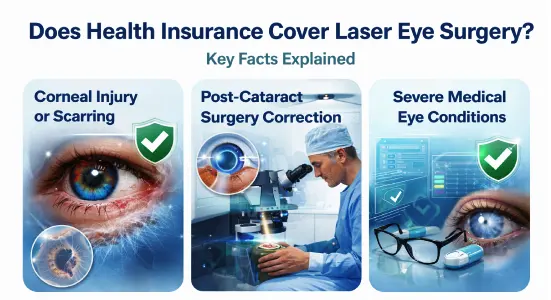
Coverage approval requires medical documentation and insurer authorization.
Laser Eye Surgery vs Vision Insurance
| Feature | Health Insurance | Vision Insurance |
| Covers LASIK cost | ❌ Usually No | ❌ No |
| Provides discounts | ❌ Rare | ✅ Yes (10–30%) |
| Covers exams | ✅ Yes | ✅ Yes |
Vision insurance often partners with LASIK providers to offer discounted rates.
Employer Benefits, FSA, and HSA Options
Employer-Sponsored Benefits
Some employers offer LASIK discounts as part of wellness programs.
Flexible Spending Account (FSA)
Allows you to pay for laser eye surgery using pre-tax income.
Health Savings Account (HSA)
HSAs can also be used to pay for LASIK and related expenses.
Cost of Laser Eye Surgery Without Insurance
Average Costs
- United States: $2,000–$3,000 per eye
- India: ₹25,000–₹60,000 per eye (varies by technology)
Cost Factors
- Surgeon expertise
- Technology used
- Clinic location
- Type of procedure
Is Laser Eye Surgery Worth the Cost?
Long-Term Financial Perspective
Over time, expenses for glasses, contact lenses, and eye care can equal or exceed surgery costs.
Lifestyle Benefits
- No dependence on eyewear
- Improved convenience
- Enhanced quality of life
How to Check If Your Insurance Covers LASIK
Review Your Policy
Look for terms like:
- “Refractive surgery exclusions”
- “Elective vision procedures”
Ask Your Insurance Provider:
- Are there medical exceptions?
- Do you offer LASIK discounts?
- Is prior authorization required?
Alternatives If Insurance Doesn’t Cover Laser Eye Surgery
- Clinic financing plans
- Zero-interest EMIs
- Medical loans
- Seasonal promotional discounts
Risks and Eligibility Considerations
Eligibility Factors
- Stable vision
- Adequate corneal thickness
- Good overall eye health
Possible Side Effects
- Temporary dry eyes
- Glare or halos
- Short-term light sensitivity
Always consult a qualified ophthalmologist before deciding.
Choosing the Right Eye Surgeon
- Board-certified ophthalmologist
- Proven experience with laser procedures
- Modern FDA-approved laser technology
- Transparent pricing and follow-up care
Conclusion
So, Does Health Insurance Cover Laser Eye Surgery? In most situations, the answer is no. However, exceptions exist when the procedure is medically necessary. While traditional insurance rarely pays for LASIK, vision insurance discounts, FSAs, HSAs, and financing plans make laser eye surgery more accessible. With informed planning, clearer vision can be a realistic goal.
Frequently Asked Questions
Usually no, unless required due to injury or medical necessity.
Yes, both are commonly accepted.
It is classified as elective, not cosmetic, but still excluded from coverage.
No, but it often provides discounted rates.
Use FSAs, HSAs, employer benefits, clinic financing, and discounts.
